
When securing electricity or natural gas for your organization, reacting to the market isn’t enough, you must get ahead of it. Today, a single macro force could be fundamentally shifting energy supply and demand: El Niño.
To help you protect your bottom line, our team has mapped out what this means for future utility pricing. Read on to discover actionable strategies your business can use right now to turn market volatility into a cost-saving opportunity.
A Super El Niño has formed and what does that mean for Natural Gas prices this winter
Forecasters say the new El Niño is on track to intensify into late 2026, boosting the chances of extreme heat, shifting drought and flood risks, and changing typical winter storm paths across the U.S.
If we have a big El Niño on top of the long-term warming trend, that just really enhances the probability that we’ll see a new record global mean temperature,
says meteorologist Nat Johnson of the National Oceanic and Atmospheric Administration, who is part of the El Niño forecasting team.
Every few years, a patch of unusually warm water in the equatorial Pacific quietly reshapes one of America’s most-watched commodity markets – Natural Gas.
The mechanism: warm oceans, mild winters, weak demand
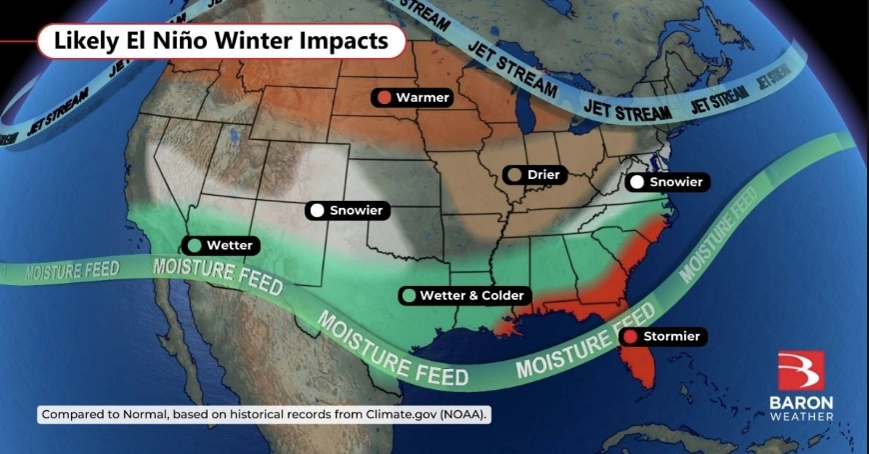
El Niño forms when sea surface temperatures in the central and eastern equatorial Pacific rise well above normal, which in turn nudges the jet stream northward. The practical result for North America is a tendency toward warmer-than-normal winters across the northern and central United States, the heart of residential and commercial heating demand.
Research compiled around past episodes backs this up: looking back since 1973, winters that featured a strong El Niño saw heating degree days run meaningfully below years without one, with the effect concentrated specifically in the strongest events rather than weak or moderate ones. Less heating demand means slower withdrawals from storage, fatter year-end inventories, and downward pressure on winter prices.
The pattern isn’t new and we have some historical data:
- The mild winter of 1994–95 coincided with an El Niño event, and natural gas prices collapsed through the back half of 1994, offering an case study in how a warm winter forecast can hollow out a commodity market well before the cold season even arrives.
- The 1997–98 El Niño ranks among the most intense on record and depressed natural gas prices throughout that period, much as the 1994–95 event had. What makes this episode instructive is what came next: a sharp flip into La Niña conditions in 1998–99 brought a genuinely cold winter. The lesson traders took
away wasn’t just “El Niño means lower prices,” but that the El Niño-to-La Niña handoff can set up an outsized rally on the other side. - The 2015–16 El Niño was the strongest on record, with Pacific sea surface temperatures running roughly 2.6 degrees Celsius above normal at its peak. The futures market priced it well ahead of the heating season: by mid-September 2015, the NYMEX winter strip was averaging around $2.91 per MMBtu, nearly 30 cents below where the equivalent strip had sat the prior year.
- The most recent strong El Niño produced one of the fastest natural gas price collapses in decades. January 2024 prices were near $3.31 per MMBtu, helped by a brief cold snap, then slid to roughly $1.58 by mid-February as one of the warmest El Nino winters on record set in.
The caveat every buyer should keep in mind
El Niño is a real and a measurable input into the natural gas price equation, but it has never been the only one. For anyone watching prices for this winter, the playbook from past cycles is straightforward: a strong El Niño points toward softer heating demand and lower prices through the heating season, but it’s also worth watching the possibility of a La Niña handoff the following year — because that’s historically where the real volatility has shown up.
You don’t have to face an unpredictable market alone
So, weather (pun intended) you’re an Electric Choice customer or buying natural gas for your organization, the specialists at AMRA Energy are equipped to guide your organization through these volatile waters. We build proactive, resilient strategies designed to mitigate risk, protect your budget, and give you total control over your energy spend.
Please give a call and schedule a no obligation review of your current energy strategy.
Sources: CME Group, U.S. Energy Information Administration, Reuters/Natural Gas
World, Natural Gas Intelligence, USA Today, American Gas Association, Offshore
Magazine, J.P. Morgan Center for Commodities.